


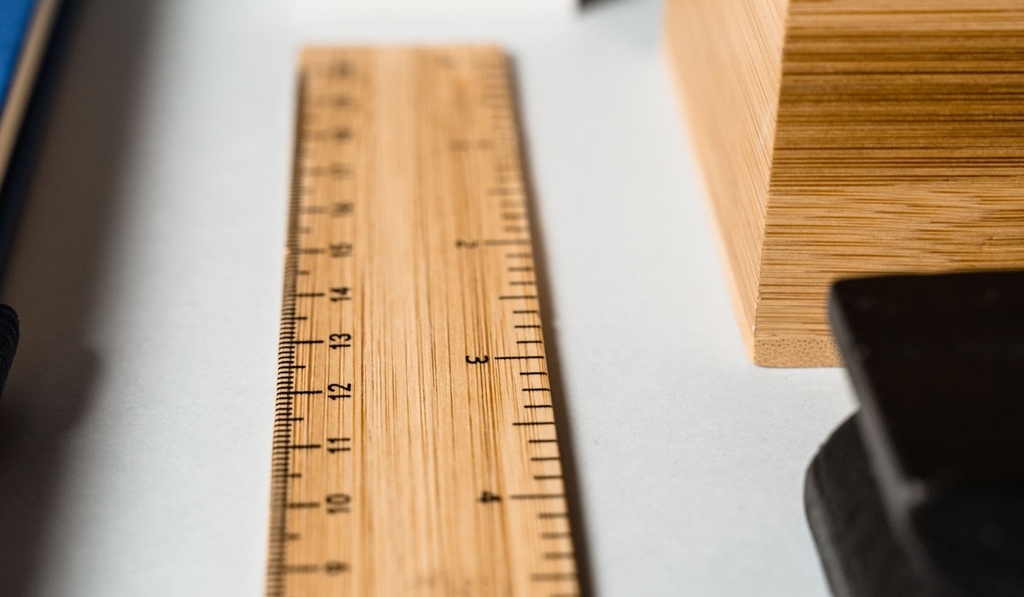
There is a wooden ruler in my toolbox, and measuring is not what it is for. Dropped between somebody’s open fingers and caught, it gives you their reaction time by the distance it fell. Students love the trick. Instructors love it more, because nothing shows a person faster that reflexes are not what is holding them back.
So, how fast are you? Closer to a Formula 1 driver than you expect, probably. And it matters far less than you would like it to.
What the clock is actually measuring
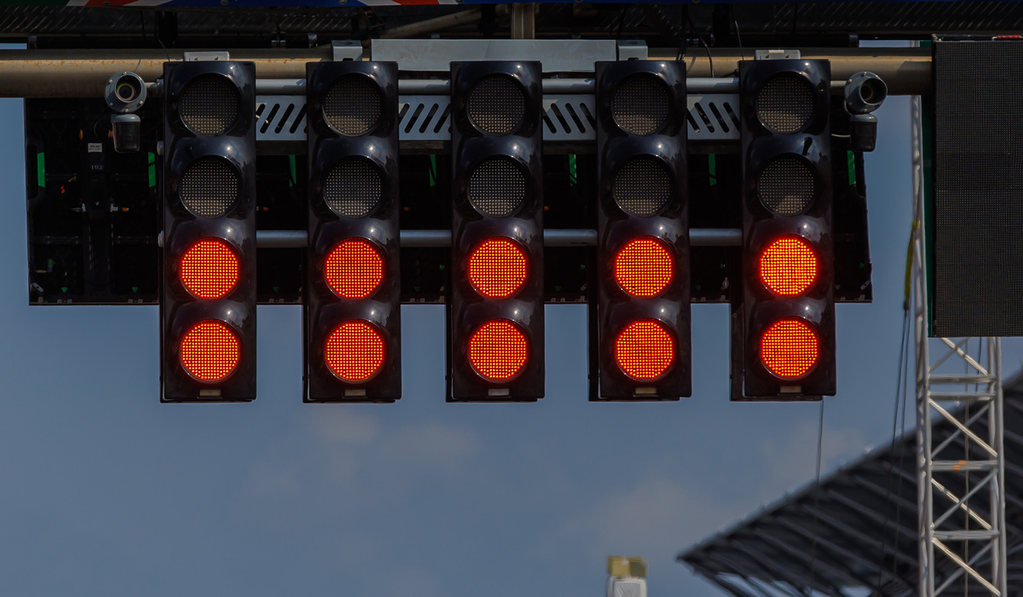
Five pairs of red lights come on one at a time at a Grand Prix start. Then a pause, deliberately randomized so that nobody can learn the rhythm, and everything goes dark at once. Lights out starts the clock. The car moving stops it.
Pure reflex that number is not. Inside it sit the seeing of the lights going dark, the deciding, the release of a clutch paddle and the car’s own response to it. Your phone measures a click instead, a shorter chain altogether, which is why the two numbers refuse to be compared even when they look alike.
The real numbers, and the ones people repeat
| Reaction at the lights | What it means |
|---|---|
| Under 0.10 s | Below the physiological floor for a reaction to the starting gun, by the research on sprint starts |
| 0.15 s | Among the quickest launches recorded in Formula 1 |
| 0.20 s | A typical Grand Prix start reaction |
| 0.25 s | A healthy adult on a simple visual test |
| 0.30 s and up | Common on a first attempt or when tired |
Start figures from published telemetry summaries and reporting, checked in October 2026. Phone tests measure a click rather than a clutch release, so the two are not directly comparable.
Typical race-start reactions come in at about 0.2 seconds. The very best launches go down to something near 0.15. A simple visual test puts an average adult around 0.25. Five hundredths of a second, then, is the gap between a Formula 1 driver and a reasonably alert person.
Five hundredths is a genuinely small gap, and nothing like the three times faster figure that gets printed everywhere.
Then there are the famous numbers, repeated everywhere and wrong everywhere. Suzuka in 2019 gets Bottas credited with 0.04 seconds. Senna gets 0.07. Neither figure is a human reaction time. The floor for a genuine reaction to the starting gun sits at about 0.1 seconds, by the research on sprint starts, and reacting to a light is slower than that again. Hence the false start rule in athletics.
Formula 1 has no such threshold at all. Transponders watch for a car moving before the lights go out, and that movement is what gets penalized.
How to test yourself without fooling yourself
| How to test yourself | What it tells you |
|---|---|
| Lights-out test online | The closest thing to a race start, with a randomized delay you cannot learn |
| Ruler drop | Catch a dropped ruler between open fingers and convert the distance. Costs nothing and is hard to cheat |
| Ten attempts, averaged | The only version worth reporting. Throw out the fastest and the slowest and average the rest |
| Your best single try | Not a reaction time. It is your luckiest guess at the timing |
The averaging method matters more than the tool. A single quick attempt is anticipation rather than reaction.
Three ways, and the table above has them. The averaging is the part people skip. Your best attempt out of twenty is not your reaction time, it is your luckiest guess at the timing, and in a race car the equivalent of that guess is a five second penalty.
Most people who do it properly land between 0.2 and 0.3 seconds. That is a good number. It is also not the point.
Why none of this makes you quick
Here is what twenty years of instructing has taught me about reflexes. The students who are fastest on a reaction test are almost never the fastest on track, and the correlation is so weak that I stopped using the ruler as anything except a conversation starter.
What separates drivers is not how fast they respond to a surprise. It is how few surprises they have. The corner exit has already been looked at. The car two positions ahead getting loose has already been noticed, and what happens if the gap closes has already been decided. By the time the event arrives, a quick driver is continuing a plan rather than reacting to anything.
One moment in a Grand Prix belongs to reaction time, and that moment is the start. Even there, best to worst on the grid covers about a tenth of a second. The other ninety minutes belong to anticipation.
What the ruler is actually for
The ruler stays in the toolbox for one useful reason. Out of it comes a perfectly respectable number for a nervous student, and with that number comes permission to say the sentence they actually need to hear. Your reflexes are fine. Your eyes are in the wrong place.
Which is almost always the case. People new to a track watch the car in front, or the apex they are already committed to, and no amount of reaction speed repairs a problem caused by looking at the wrong object.
Take the test if you want to. The useful version is ten attempts averaged honestly, and the 0.2 seconds it gives you is the least interesting number in this sport.
Questions about reaction times
What is the average F1 driver reaction time?
Around 0.2 seconds at the start, with the quickest launches down near 0.15. An average adult lands around 0.25 on a simple visual test.
Is a reaction under 0.1 seconds possible?
Not as a genuine reaction. Research puts the physiological floor for a reaction to the starting gun at about that figure, and reactions to a light are slower. In Formula 1 a jump start is judged by the car moving early, not by the reaction number.
Did Bottas really react in 0.04 seconds?
That figure is repeated often and it is not a human reaction time. Anything under about 0.1 seconds is anticipation, not reflex.
How do F1 start lights work?
Five pairs of red lights come on one at a time, then all of them go out together after a randomized pause so nobody can learn the rhythm.
Does a fast reaction time make you a fast driver?
Barely. Reaction matters at the start. The rest of a race is anticipation, which is a different skill and the one that separates drivers.
Jake Holloway is a club racer, track-day instructor, and motorsports editor based near Charlotte, North Carolina. He has raced karts, Legends cars, Spec Miatas, and amateur endurance cars, and he writes for GreenyCars about how racing actually works, from the rule book to the pit lane.
More Stories
The Dakar Rally and Why Finishing It Counts as Winning
The Ten Greatest F1 Drivers, Ranked by a Club Racer
The F1 Circuits Every Fan Should Know, and What Each One Is For
The F1 Races That Stayed Unsettled Until the End
F1 Driver Nicknames, the Professor to Mr. Saturday