
PexelsMy first pyrometer was worth forty bucks, but it has been worth more to me than any other book in my library. The three numbers you get after the heat is done are the only truthful information about the tire’s performance. You put the probe into the tire tread in three places: at the inner side, middle, and outer side and jot down the temperature readings before they fade away. The shape of these three numbers gives you the information on whether the tire has been working hard or just being carried around.
The first time I used it properly was after a Spec Miata race I thought I had driven rather well. The outside edges came back cooked and the middles were still cold. Two pounds of pressure and one click of front bar later, the car was a second a lap quicker, and my hands had done nothing different at all. I have been suspicious of my own opinion about a car ever since, because the tire had been telling the truth all along and I had not been listening.
The reason why Formula 1 always argues about tires is similar, and the only difference is that the questions there can be answered with far better instruments. Grip is not achieved because of the compound being soft. Grip is achieved due to the compound being in the working window. And that window is significantly smaller than what most viewers guess. The information below can be found in the announcement from Pirelli concerning their 2026 tire line and in what Formula 1 published alongside it.
The five compounds and the reasoning behind using three
| Label that weekend | What it is | Where it fits |
|---|---|---|
| Hard, white sidewall | The hardest of the three compounds chosen for that event | Long stints, hot circuits, low deg |
| Medium, yellow sidewall | The middle choice of the three | The default race tire at most events |
| Soft, red sidewall | The softest of the three | Qualifying, short stints, street circuits |
| Intermediate, green sidewall | Wet tire for a damp surface | Drying track or light rain |
| Full wet, blue sidewall | Wet tire for standing water | Heavy rain, safety car starts |
Labels are relative. The medium at one race can be harder rubber than the soft at another.
A large variety of dry compounds was created by Pirelli and is labeled according to the hardness of the compound. Three of them are brought to every circuit, with the titles hard, medium, and soft given for that weekend only. This is the most confusing part. The problem is that the meaning of one and the same name can vary depending on the racetrack.
This season saw an adjustment in the number of compounds from six to five and the explanation was provided alongside it. The softest compound had been added last year to cater to slow street circuits, but it was taken off due to its performance being too close to that of the compound above it. As a result, two tires fulfilling the same function leave a team with no choice. In addition to slicks, there are two wet range tires, intermediate which is used for slightly wet surfaces and full wet which is required for standing water. These two types of tires are the ones that are never enough for anybody, and I include myself in that.
The window television never shows an audience
Every compound has a range of temperature in which it is efficient. Outside it the compound works in a different manner and its numbers on the sidewall do not mean anything. Below the window the rubber is hard and slides. The surface heats up and the bulk does not, which I learned on a cold March morning by spinning at the first corner of an out lap. Consequently, the driver pursues grip which always seems to be late in arriving. Above the window the surface goes greasy and the lap times fall away, and it turns out that the tire will not be able to return to its original state even when it received the greatest possible care afterward.
The softer the compound, the narrower the range and hence the trade-off that a team makes each time it opts for tires. The softer rubber provides high grip while it is happy and it gives up sooner when it is no longer happy.
My version is smaller and cheaper and exactly the same.
I have spent my time trying club tires that never worked because it was too cold that morning and the track was too green. An identical set went away on me in five laps in August. At that level we operated without employing the use of blankets. The first lap of every session was basically a negotiation instead of a lap, and those two out laps taught me more about warm up than any engineer has possibly told me so far.
Degradation is two problems under one name
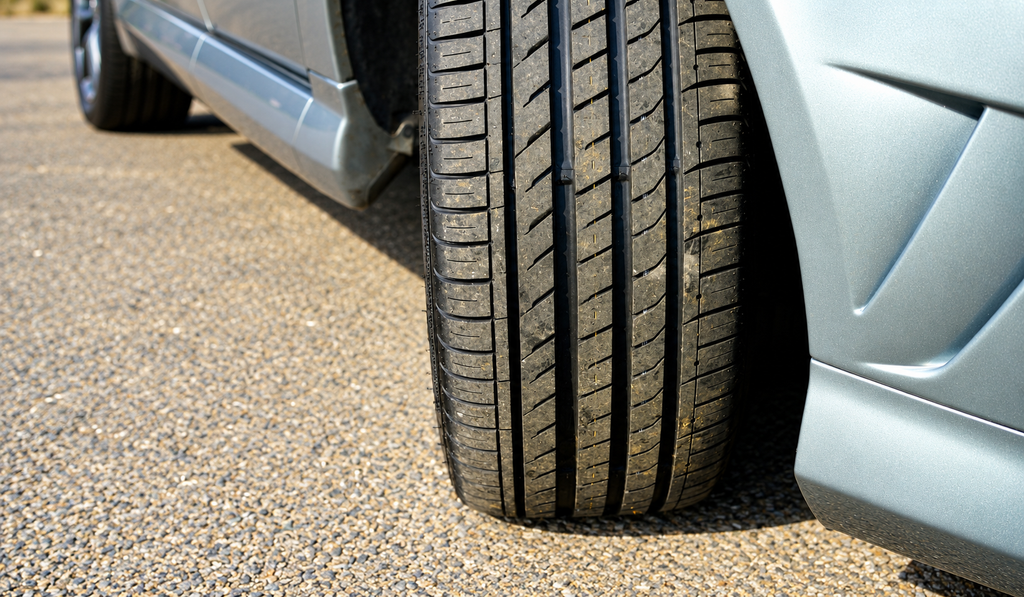
PexelsPeople utilize the term with respect to one aspect, but it includes two meanings. One refers to wear, which means losing some bits of rubber from the tire and putting it on the road. Then there is thermal degradation, in which the tire overheats and stops delivering. It still looks perfectly serviceable to anybody standing in the pit lane.
People speak of thermal as the main reason for races being determined. When they tell a driver to manage, they mean that he should lift earlier, carry more speed in the middle of the corner and stop asking the tire for the last of the front end. To an outsider, this is not visible from a helicopter, as the only visible element is the lap time that keeps sliding away by tenths. The radio communication gets shorter.
I used to have a section in my notebook called heat cycles, and I still have this notebook today, despite the fact that nobody has asked to see it in the last fifteen years. Once a set has gone through six cycles, it cannot be regarded as the set you bought.
My dad has always held the same column for street tires, which is something that no one in our family found strange. This type of calculation is something that a person learns at the club level. Used tires from a van are half the price of new ones and about two thirds of the grip, and the difference between these two numbers is what decides a season.
What has to be done according to the rules
In a dry Grand Prix at least two specifications of dry-weather tires have to be used, with one of them being a mandatory race specification.
This is why a one-stop race can still occur, as without this rule a team with durable tires could reach the finish without stopping at all.
Monaco was given an experiment in 2025. Drivers were made to use three sets and therefore to stop twice, and the result was not what anybody had hoped for. Teams found ways to slow the field down for a teammate. The racing did not improve, and the clause was struck out of the rules written for this year.
Everything else that happens is degradation coming into play. I have made that mistake before. I remember a club enduro where I stayed on the track for four extra laps and lost the position I had been fighting for the last hour. A tire is working well in the first part of the race and then it starts to slip. The decision is made lap after lap and it is a matter of determining whether it is better to pit for twenty seconds rather than suffer from sliding.
What occurs this year
| What changed for 2026 | Detail |
|---|---|
| Dry compound range | Five compounds instead of six |
| The dropped compound | The softest one, cut because its lap time was too close to the next step |
| Tire width | Narrower front and rear than the previous cars |
| Wheel size | Still 18 inches |
| Design target | Built for cars with less downforce and moving wings, using team simulations |
Based on the Pirelli announcement of the 2026 range and Formula 1 coverage of it.
The tires are narrower at both ends and this is done in conjunction with the process of removing weight and drag from the cars. The eighteen-inch wheels remain unchanged. Less downforce means that the tire’s task is different. The cars will not rest on the floor as much as before and the load at each corner will vary more than in the past.
Building the tire range was based on simulations run by the teams, instead of on running cars, for the simple reason that the cars did not exist yet.
This means that the opening few races were employed in finding out just how good or bad those simulations had been in reality. I have already had the opportunity to observe the performance of computer-simulated tires on track once before, at a far lower level. The track has always had the final say anyway.
Instead of seeing the tire colors on the sidewall, I can pay attention to the first few laps. The first few laps provide most of the information because a tire that is coming in will get progressively better lap times while a tire that is in trouble will do well only for the second lap. This is the first reliable signal you have at home before you see it in the graphics.
The second portion of the race is characterized by tire degradation, with times being lost in increments of tenths of a second. This aspect of the race is indicative of how tires are behaving on other laps as well. Although an in-lap is probably also of interest, a driver may lose four seconds in the preceding lap when the tire is being held back, but the commentators will say they are just watching fuel levels.
Back to the tool that costs forty dollars
I still have the pyrometer in my workshop. It gives me the same readings as an F1 team using equipment worth a fortune, and I still write them on the same page of the same notebook. The difference between the readings indicates whether on one edge of the tire the temperature is much increased, and this suggests that we need to adjust the camber. A cold middle indicates that the pressures are wrong, and although the magnitude of the project changes, the problem remains the same.
I have never worked for a team that won anything on rubber alone, and neither has anybody else. The teams that win are the ones who answer that question fastest. They are also the ones willing to give up half a second on Saturday to keep four tires inside their window on Sunday afternoon.
What people ask me about tires
Five dry compounds this season, from the hardest to the softest, plus an intermediate and a full wet. Three of the dry ones come to each event.
Because it was too close in lap time to the next one up. Two tires doing the same job give teams nothing to choose between.
Two things at once. Rubber wearing away, and the tire overheating so it stops delivering while it still looks usable. The second one decides more races.
Yes. A dry Grand Prix requires at least two different dry specifications, so a stop is unavoidable. Rain removes that requirement.
Jake Holloway is a club racer, track-day instructor, and motorsports editor based near Charlotte, North Carolina. He has raced karts, Legends cars, Spec Miatas, and amateur endurance cars, and he writes for GreenyCars about how racing actually works, from the rule book to the pit lane.
More Stories
Niki Lauda and the Forty-Three Years After the Fire
DRS in F1 and What Replaced It for 2026
How to Become an F1 Driver When Karting Is Only the First Step
The F1 Power Unit Explained and Why the Lap Is Now an Energy Budget
F1 Driver Salaries and What the Reported Numbers Actually Mean