
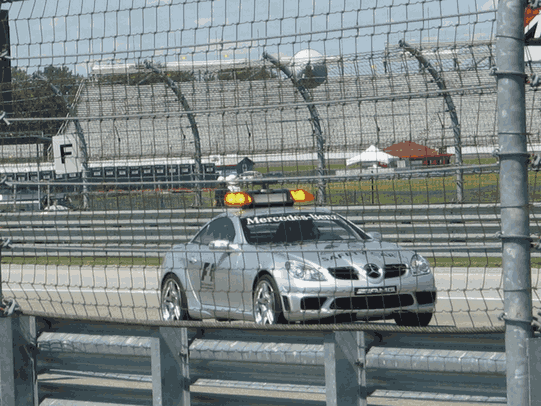
I put in a protest at a regional race once. A driver had gone by me under a full-course yellow and held his place, so I objected. It set me back a hundred dollars and twenty minutes on my Sunday. Three men read what I had to say and the timing sheet, made up their minds the pass predated the flag and returned the money with an apology I had no use for. In the end they were right. The paperwork showed my recollection of the sequence was off.
It is good background when one watches Formula 1, where the very same set up is in force at the top of the sport and is called a conspiracy about once a month. One driver is given five seconds, another nothing for what appears to be the same infraction, and the paddock concludes the stewards are either bought or inept. The truth of it is four people, a rulebook, some published guidelines and a panel that is different each weekend.
Who are the stewards
| The panel at every Grand Prix | Where they come from |
|---|---|
| The chair | A senior FIA appointee who runs the panel, drawn from a pool of four |
| The second FIA steward | Drawn from a pool of five |
| The driver steward | A former Formula 1 driver, drawn from a pool of three and rotated through the season |
| The national steward | Nominated by the host country federation for that event |
| Requirements | An FIA Super Licence, annual training and a written assessment |
| Pool size | Twelve people across the whole season, down sharply from a decade ago |
| At six demanding events | The FIA appoints four of its own, and the panel sits five |
Panel composition as published by the FIA for 2026. The regulations set a minimum of three FIA stewards and a maximum of four, with the host federation adding one more. The six-event expansion is an FIA scheduling decision rather than a rule.
Licence, go through yearly training and sit a written test at the close of it. The pool has been cut back considerably over the last ten years by design; it is easier to be consistent with twelve.
A former driver in the room
One spot is reserved for someone with time in these cars and the names change with the season. We have had Derek Warwick, Danny Sullivan, Emanuele Pirro and Vitantonio Liuzzi in it, with Liuzzi, Pedro Lamy and Warwick doing so in 2026. There is a simple logic to it. A collision in the braking zone means something else to the man who has been in one at three hundred kilometers an hour on cold rubber with a car next to him. The panel is better for having that view in the room rather than reading of it later.
How an investigation is run
| Step | What happens |
|---|---|
| 1. Report | Race control notes an incident and refers it to the stewards |
| 2. Evidence | Timing data, telemetry, onboard footage from several cars and radio transmissions |
| 3. Hearing | The drivers involved are summoned and asked to explain what they were doing |
| 4. Guidelines | The Driving Standards Guidelines and the Guidelines for Penalties and Points set the starting point |
| 5. Decision | Published as a written document, usually within the hour |
The sequence an investigation follows at a Grand Prix weekend, as described in FIA material and published decisions.
What can be appealed
| Decision | Can it be challenged |
|---|---|
| Time penalties | No appeal |
| Drive-through and stop-and-go | No appeal |
| Reprimands | No appeal |
| Grid drops | No appeal |
| Right of review | Fourteen days, and only with a new element that is significant, relevant and was unavailable at the time |
| International Court of Appeal | In Paris, independent of the stewards, reached through a team national federation. Weeks or months, and rarely successful |
Appeal routes as published for the 2026 season. Article numbers are not given here, since the 2026 renumbering has already caught out several published explainers.
Then there is the right of review. A team has two weeks to present the stewards with something of import that was not on hand when the call was made. The threshold for that is high. Red Bull put it to the test after the 2023 Austrian Sprint but the panel would have none of it as the telemetry in question could have been had. Past that is the International Court of Appeal in Paris, independent of the race officials and accessed via the national federation. Those appeals take weeks or months and seldom come to anything.
Inconsistency in the decisions
The FIA has put out the figures on this and they should be known before the next row. In 2025 the stewards were presented with 509 cases and incidents, put 405 to the investigation and put pen to paper 410 times. Penalties were handed down in 153, just over a quarter of everything referred to them. Two review petitions and three protests were dealt with in the same span.
So formal challenges came in on five of more than four hundred decisions. That does not put the matter to rest because the ones in dispute are the championship deciders and the routine calls are forgotten. Guenther Steiner made the structural point after Monaco, taking issue with laymen ruling on million dollar careers. He was reprimanded for the words and said sorry, but the question he posed over permanent professional stewards lingers.
My hundred dollars gave me twenty minutes and an answer I did not care for. The drivers get a hearing and a verdict in writing within the hour which they will be questioned on in front of a camera before they have even read it. The structure is identical. The scrutiny is not.
What readers ask about F1 stewards
Four officials at every Grand Prix: a chair, a second FIA steward, a former Formula 1 driver and a steward nominated by the host country federation. At six events the FIA adds a fourth of its own and the panel sits five. All hold an FIA Super Licence and pass an annual assessment.
Not in most cases. Time penalties, drive-throughs, stop-and-gos, reprimands and grid drops are final. A team has fourteen days to request a review, but only with new evidence that was unavailable at the time.
The race director runs the event itself, including the start procedure, safety car and red flags. The stewards judge incidents and decide penalties, and the two roles are held by different people.
To give the panel a competitor’s view of what a situation looked like from the cockpit. The seat rotates through the season among three former Formula 1 drivers.
Twelve within a rolling twelve months bring a one-race suspension, after which twelve points are removed. Each point expires twelve months after it was issued.
Jake Holloway is a club racer, track-day instructor, and motorsports editor based near Charlotte, North Carolina. He has raced karts, Legends cars, Spec Miatas, and amateur endurance cars, and he writes for GreenyCars about how racing actually works, from the rule book to the pit lane.
More Stories
The Dakar Rally and Why Finishing It Counts as Winning
The Ten Greatest F1 Drivers, Ranked by a Club Racer
The F1 Circuits Every Fan Should Know, and What Each One Is For
The F1 Races That Stayed Unsettled Until the End
F1 Driver Nicknames, the Professor to Mr. Saturday