


The most expensive noise I ever made was a missed downshift at Roebling Road. Third instead of fifth, engine past the limiter, and a rebuild bill that two months of overtime went to clear. Every club racer with an H-pattern gearbox has a version of that story, and most of us tell it less often than we think about it.
A Formula 1 driver cannot make that mistake. He is better than I am, certainly, but the real reason is that his gearbox refuses to accept the instruction. People tend to get that backward.
Paddles look like automation. They are not. Regulations forbid a car that chooses its own gears, so every shift in a Grand Prix begins with a driver pulling a lever, several thousand times an afternoon. The clever part arrives in the two thousandths of a second after he does.
Eight gears, and no choice about it
| The gearbox rules | Detail |
|---|---|
| Forward gears | Eight, mandatory since 2014 and unchanged for 2026 |
| Reverse | Mandatory, and almost never used |
| Ratios | Declared to the technical delegate by the first race. For 2026 only, one change is allowed during the season |
| Banned | Continuously variable transmissions, and any fully automatic gear change |
| Clutch | A paddle behind the wheel, not a pedal. Used at the start and when leaving the pit box |
| Where it is written | Article C9 of the technical regulations |
Regulations as published for the 2026 season, checked in October 2026.
Two things in that sentence are worth stopping on. Teams cannot run fewer than eight, even at a circuit where the eighth would never be used, and they cannot run more. Continuously variable transmissions, which would in principle be faster, are banned outright.
The ratios themselves are declared to the technical delegate no later than the first race of the season. A team picks eight numbers in winter and lives with them at every circuit from Melbourne to Las Vegas, and that choice gets made months before anybody knows which tracks will suit the car. For 2026 alone the regulations allow one change of those ratios during the season, which is a concession to a new set of rules nobody had data for.
Reverse is mandatory too, and almost never used. It exists so a driver who spins into a gravel trap can get himself out of it rather than ending a race in a position a marshal would have to fix.
Why there are two barrels instead of one
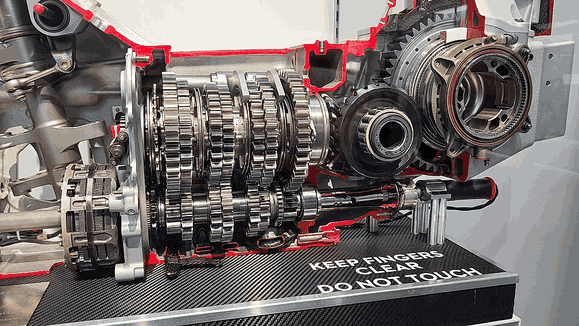
Here is where a gear change stops being one action.
An ordinary sequential gearbox runs on one shift barrel, and one barrel can only do things in sequence. Unlock the gear in use. Move. Lock the next one. Between unlocking and locking there is a moment, brief but real, when nothing reaches the rear wheels.
Two barrels change that. Odd gears go on one, even gears on the other, and the next one can be engaged while the current one is still holding. Both are connected for a sliver of time, and drive never fully stops.
Lap time is the reason it exists. Roughly three tenths per lap, by published estimates. Over a Grand Prix distance that is an enormous amount of time to find inside a component most spectators never think about.
Nobody agrees on how long a shift takes
| The numbers | What sources say |
|---|---|
| Seamless shift, mechanical | Two to three milliseconds by several accounts |
| Paddle to gear engaged | Around fifty milliseconds by others, probably measuring a longer chain |
| Pre-seamless gearboxes | Ten to fifteen milliseconds, for comparison |
| Lap time gained | Roughly three tenths of a second, by published estimates |
| Upshift window | Must complete inside a fixed time set by the regulations |
| Downshift window | Longer than the upshift, to stop the gearbox acting as traction control |
| Season allocation | None. The six-event rule went from 2022, and the season quota of casings and internals has since gone too. Figures of four or five sets describe 2024 and 2025 |
| Penalty | None for the gearbox. The 2026 sporting regulations ration power unit elements instead |
Figures as published by technical explainers and reporting. Sources disagree on shift times and on the exact season allocation, so these are given as a range rather than as settled numbers.
The published figures sit far enough apart that averaging them would amount to inventing one.
Two to three milliseconds is what some sources give for a modern seamless shift. Around fifty milliseconds is what others give for the stretch between the paddle moving and the new gear engaging. Ten to fifteen turns up in older descriptions of gearboxes built before the seamless era.
Those are probably not the same measurement. The shortest figure describes the mechanical overlap inside the gearbox. The longest plausibly includes the electronics, the hydraulics and the engine torque management either side of it, the same distinction that turns up in published reaction times.
The regulations add their own numbers from a different direction. An upshift has to complete inside a fixed window, and a downshift gets a longer one, which exists to stop teams using the gearbox as a traction control device.
What the driver actually does
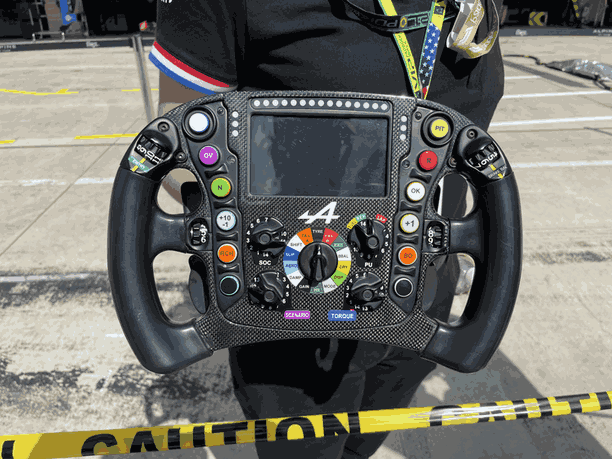
Two paddles for gears, one for the clutch, and no pedal.
Twice in a normal race the clutch paddle matters, at the grid and at the pit box exit. Every other shift is handled inside the gearbox, which disengages and reengages drive with no clutch input from the driver at all.
What the driver cannot do is let the car shift for itself. Fully automatic gear changes are banned, and so is any system that selects a ratio without a human input. The paddle is not a request. It is the instruction.
The rule that used to cost grid places
Gearboxes have their own allocation, separate from the power unit, and this is a part of the rulebook that has moved recently enough that old explainers get it wrong.
The previous version required a gearbox to survive six consecutive events before it could be changed without penalty. A season allocation of casings and internals replaced it from 2022, and that quota has since gone the same way. Whatever the 2026 rulebook rations, the gearbox has fallen off the list, and the table above has the current position.
Explainers that look perfectly current still quote allocations from two seasons ago, which is how most of the confusion around this rule gets manufactured.
Where this came from, and it was not long ago
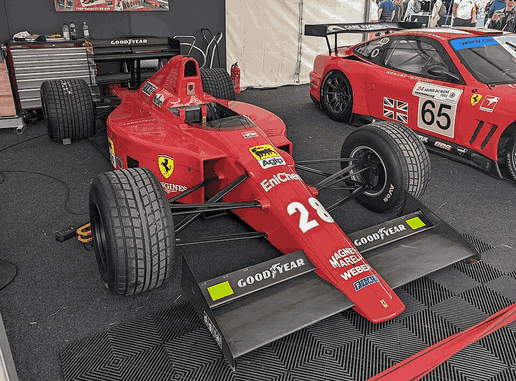
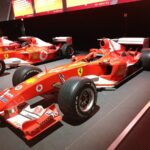
The 1989 Brazilian Grand Prix opened that season, and Ferrari turned up to it with a car that had no gear lever. Shifting had moved to paddles behind the wheel, by way of a semi-automatic transmission designed by John Barnard. Most of the paddock considered the thing fragile. Nigel Mansell won on its debut.
Within a few seasons every team had copied it. Within a decade the manual gearbox had vanished from the top of the sport entirely. Most people have since met the same technology in a road car without knowing where it came from.
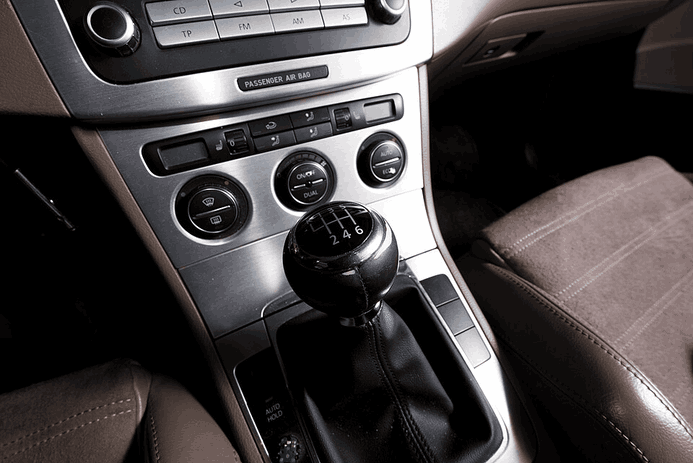
My Spec Miata still has a lever and three pedals, and I still think about Roebling Road when I am tired at the end of a stint. The Formula 1 driver has been relieved of that particular fear, and in exchange he pulls a paddle several thousand times an afternoon, each pull resolving in less time than it takes him to register that he has done it.
Questions about F1 gearboxes
How many gears does a Formula 1 car have?
Eight forward gears and one reverse gear. That has been mandatory since 2014 and is unchanged for 2026.
How fast does an F1 gear change happen?
Published figures range from two or three milliseconds for the mechanical overlap to around fifty milliseconds for the whole chain from paddle to engaged gear.
Are F1 gearboxes automatic?
No. Fully automatic gear changes are banned. The driver pulls a paddle for every shift, several thousand times in a race.
Does an F1 car have reverse?
Yes, and the regulations require it, though a driver may go a whole season without using it.
Is there still a penalty for changing an F1 gearbox?
No. The rule requiring six consecutive events went from 2022, and the season allocation of casings and internals that replaced it has since gone as well. The 2026 sporting regulations ration power unit elements rather than gearboxes.
Jake Holloway is a club racer, track-day instructor, and motorsports editor based near Charlotte, North Carolina. He has raced karts, Legends cars, Spec Miatas, and amateur endurance cars, and he writes for GreenyCars about how racing actually works, from the rule book to the pit lane.
More Stories
The Dakar Rally and Why Finishing It Counts as Winning
The Ten Greatest F1 Drivers, Ranked by a Club Racer
The F1 Circuits Every Fan Should Know, and What Each One Is For
The F1 Races That Stayed Unsettled Until the End
F1 Driver Nicknames, the Professor to Mr. Saturday