



I can tell you what a front wing costs on my car to the dollar, because I have bought three. Two hundred and eighty each, plus shipping, plus the afternoon spent drilling out the old mounting tabs. Nobody in Formula 1 can tell you the same thing about theirs, and that is the first thing worth understanding about money in this sport.
Component prices in Formula 1 are estimates. No team publishes a parts list, the figures that circulate come from journalists, former engineers and the occasional supplier who talked, and they disagree with each other by factors of two and three.
Why there is no real price list
| Part | Published estimates | Note |
|---|---|---|
| Power unit | 8 to 15 million dollars | The single most expensive item on the car by a wide margin |
| Chassis, the survival cell | 650,000 to 1.2 million dollars | Carbon monocoque, built in small numbers |
| Gearbox | 250,000 to 600,000 dollars | Must last several race weekends under the rules |
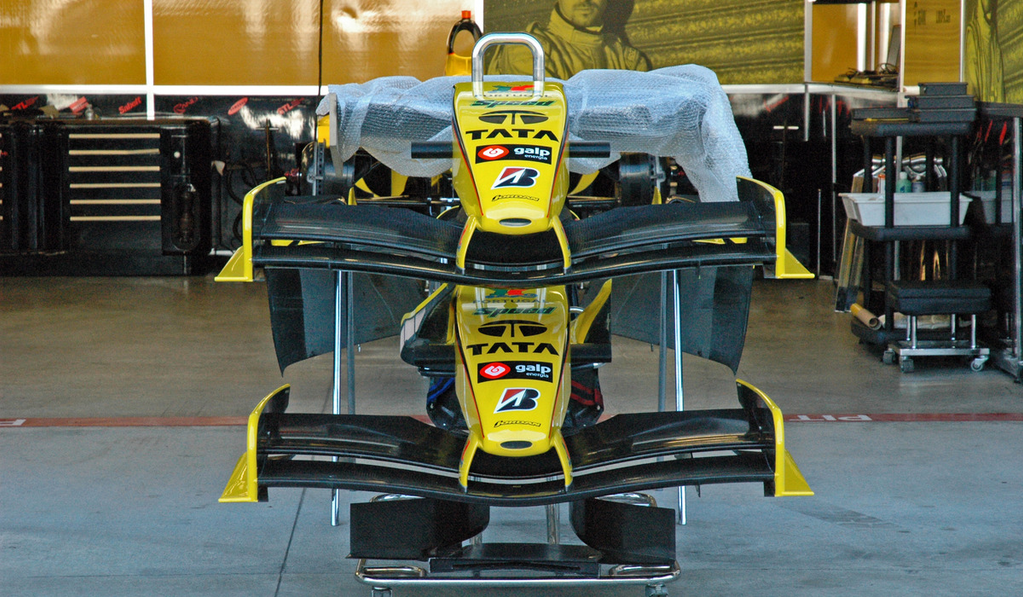
| Front wing assembly | 140,000 to 300,000 dollars | The figure quoted whenever one is destroyed on lap one |
| Rear wing assembly | 85,000 to 150,000 dollars | Reconfigured race by race |
| Steering wheel | 50,000 to 100,000 dollars | A control unit with a screen, built around one driver |
| Halo | 15,000 to 17,000 dollars | Titanium, mandatory, made by certified outside suppliers |
| A complete car | 15 to 30 million dollars | Depending on whether the power unit is counted and whose estimate you take |
Every figure here is a published estimate rather than a confirmed price. No team releases a parts list, and sources differ by a factor of two or three on most lines. Checked in October 2026.
Three reasons. Most parts are made in quantities of ten or twenty, so there is no unit price in any normal sense. Teams build their own components, meaning the cost is labor and tooling and a carbon oven rather than an invoice. And the numbers that do leak are commercially sensitive, which is a polite way of saying nobody confirms them.
What you get instead is a range, and the table above gives the honest version of it: the spread between the lowest and highest published figure for each part.
Look at the front wing row. Published estimates run from about 140,000 dollars to 300,000. That is not precision, it is a reminder that the whole category is informed guesswork.
What the cost cap actually covers
The cap is the one number that is not a guess. For 2026 it sits at 215 million dollars, with a separate limit of 130 million for power unit manufacturers.
What it covers is car design, manufacture, operations and most of the staff. What sits outside it: driver salaries and the three highest-paid staff. So a team’s real annual spend is higher than the cap, sometimes considerably, and the published figure for any team’s budget depends entirely on which of those buckets the person quoting it included.
That is worth holding on to, because it explains why one article says a team spends 215 million and another says 400, and both are describing the same team in the same year.
The front wing problem

Somewhere between 140,000 and 300,000 dollars, destroyed by a touch on lap one, is the most instructive number in the sport.
It is instructive because of what it does to decision-making under a cost cap. Before 2021 a destroyed wing was an accounting nuisance. Now it is a quantity of development that will not happen later in the season, and teams genuinely race differently because of it.
A driver who loses three front wings in the first half of a season has not only cost his team money. He has cost it an upgrade, which arrives at the circuit two races later than planned, or does not arrive.
What it costs to get there
| The ladder | Cost per season |
|---|---|
| Karting at international level | 50,000 to 100,000 dollars a year, more at world level |
| Formula 4 | 200,000 to 300,000 dollars |
| Formula 3 | Around a million dollars |
| Formula 2 | 2 to 3 million dollars, usually across two seasons |
| F4 to a second year of F2 | Above 16 million dollars for a clean run |
| The cost cap | 215 million dollars for 2026, with 130 million for power unit manufacturers |
Junior category costs from the closed fact-check of our article on reaching Formula 1. These are prices families actually pay, rather than estimates.
The junior ladder has prices that are better documented, because the people paying them are families rather than corporations.
Karting at a serious level runs 50,000 to 100,000 dollars a year. Formula 4 is a few hundred thousand. Formula 3 approaches a million, and Formula 2 runs two to three million per season, usually across two seasons. A clean run from F4 to a second year of F2 has been put at over sixteen million dollars.
Those numbers are not estimates in the same way. Somebody wrote a check.
What this looks like from below
My own racing costs twelve thousand dollars in a good season, split four ways with three other people, and I know every line of it because I wrote them all down.
The gap between that and a Formula 1 front wing is not really a gap in money. It is a gap in what money buys. My twelve thousand buys a season of racing. Their three hundred thousand buys one component that might survive the first corner.
What I take from the whole subject is narrower than the headline numbers suggest. Formula 1 is not expensive because the parts are exotic. It is expensive because almost everything on the car is made once, by hand, to answer a question that will be obsolete in four races. The parts are not products. They are experiments with a race number on them.
Questions about F1 costs
How much does an F1 car cost?
Published estimates run from 15 to 30 million dollars depending on whether the power unit is included. No team confirms a figure, so every number in circulation is an estimate.
How much does an F1 front wing cost?
Between about 140,000 and 300,000 dollars by published estimates. The spread tells you how little of this is confirmed.
What is the most expensive part of an F1 car?
The power unit, by a wide margin. Estimates put it between 8 and 15 million dollars.
What is the F1 cost cap for 2026?
215 million dollars, with a separate limit of 130 million for power unit manufacturers. Driver salaries and the three highest-paid staff sit outside it.
Why do reported team budgets differ so much?
Because the cap excludes several large categories. A figure of 215 million and a figure of 400 million can describe the same team in the same season.
Jake Holloway is a club racer, track-day instructor, and motorsports editor based near Charlotte, North Carolina. He has raced karts, Legends cars, Spec Miatas, and amateur endurance cars, and he writes for GreenyCars about how racing actually works, from the rule book to the pit lane.
More Stories
The Dakar Rally and Why Finishing It Counts as Winning
The Ten Greatest F1 Drivers, Ranked by a Club Racer
The F1 Circuits Every Fan Should Know, and What Each One Is For
The F1 Races That Stayed Unsettled Until the End
F1 Driver Nicknames, the Professor to Mr. Saturday