
In club racing a flag and the honor system are enough to neutralize a race. The corner workers put up yellow at every station, everyone stays in position and the only form of enforcement is the four hundred or so on hand who will have words with you in the paddock later. It is a workable arrangement when what is at stake is a trophy and a handshake. Formula 1 is not in a position to run on such an honor system so it has devised two ways to slow things down. The choice of which to use has been more decisive in Grands Prix than most overtakes.
To the spectator the confusion lies in the fact that the same incident can be met with different responses. A car halts on the exit of a corner and the virtual safety car is in. One stops elsewhere, marshals have to go out on the track and the real thing comes out. From the grandstand the crash does not look any different but the ramifications for the race are huge.
Two systems, one purpose
| Safety car | Virtual safety car | |
|---|---|---|
| A car on track | Yes, leading the field | No |
| What happens to gaps | They vanish, the field bunches nose to tail | They stay roughly where they were |
| How drivers slow | Follow the car at its pace | Hold a minimum delta time shown on the dash |
| Pit stop cost | Lowest of all | Reduced, but less so |
| Restart | Rolling, with the leader setting the pace | The race goes green everywhere at once |
| Lapped cars | May be waved past to rejoin the back | Stay where they are |
The two neutralization systems side by side, as run under the 2026 Sporting Regulations.
The VSC was introduced in 2015 in the wake of Jules Bianchi’s accident at Suzuka the year before, when a recovery vehicle was operating under local yellows next to a live track. The intention was to put the brakes on the whole field without the bother of putting a physical car out there, and it has served its purpose. Race control now has something between waving some yellow flags and having to reset the race.
Why the call of the day matters
It is all about pit stops and the numbers bear looking at. To stop while the green is flying costs a driver the better part of half a minute to the cars still out there. With a VSC the entire field is going slowly so the loss is less. Under a full safety car it is even less since the field is bunched and a driver can pull in without ceding track position to those who stay out.
That is the source of the lottery the viewing public deems unfair. A driver near the pit entry when the word comes in has a stop that is almost free. Another who was past it ten seconds before has to put in a lap at reduced speed first and forgoes much of the advantage. There is nothing right or wrong in either case. Strategists will put in an afternoon figuring out what happens if a neutralization is called on a given lap, and the answer is different every few laps.
What is required by the rules
| Safety car period | What happens |
|---|---|
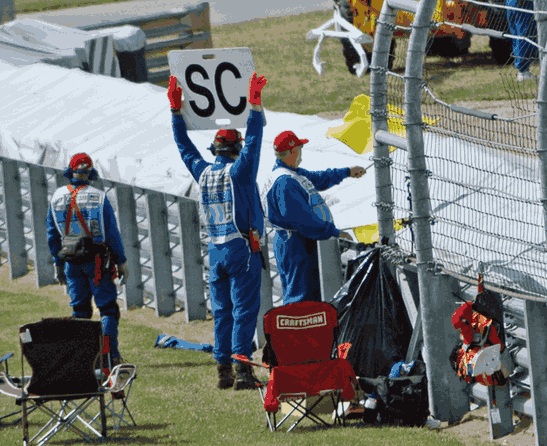
| Deployment | Boards and lights show SC, overtaking stops, the field forms up behind the car |
| Pit lane | Stops are allowed, and cost far less time than under green flag running |
| Unlapping | Race control may release lapped cars, after which they must unlap themselves and rejoin the back of the queue |
| 2026 trigger | A car qualifies only if it was already a lap down crossing the first safety car line for the second time after deployment |
| Leader pacing | The leader must stay within ten car lengths of the safety car once it has collected the field, until the safety car pulls in |
| Restart | The safety car pulls in and the leader controls the pace to the line |
Procedure as published for the 2026 season. Sources differ on whether unlapping is at the race director’s discretion or automatic once conditions allow.
Overtaking is off limits under either system, barring a lapped car being waved through to get back in the queue. The table above lays out the sequence of a safety car period and the procedure for the lapped car is what caused the sport’s most renowned dispute in recent times.
With the VSC the system is unforgiving and automatic. What the table below cannot show is how little room a driver has. The delta is monitored in every sector so there is no way to make up a tenth lost in one place. And the published figures on just how much the VSC slows the field vary by ten percentage points.
| Under a VSC | Detail |
|---|---|
| The delta | A minimum time per marshalling sector, updated roughly every fifty meters |
| How much it slows the field | Published figures put it around thirty percent, with some sources closer to forty |
| Enforcement | Running below the delta brings a penalty, escalating from five seconds upward |
| Ending | Panels flip to green between ten and fifteen seconds after the warning |
| 2026 energy effect | Laps spent coasting are laps spent harvesting, so drivers reach the restart with more battery |
VSC mechanics as published, checked in October 2026. The pace reduction figure is the one point where sources disagree.
2026 changes
There are three of them and the last was a bit of a surprise. Two are procedural and in the tables: a firmer trigger for unlapping and tighter pacing in the wake of the safety car to put an end to the chaos of restarts.
The third has to do with the cars. They are more demanding on energy management than the old ones. A lap coasting behind a neutralization is a lap of harvesting so the driver has more battery at the restart than he would have done otherwise. Braking has changed too. A field that takes longer to come to a halt is a factor in the restart. Measurements from Melbourne put peak deceleration at one corner at 3.3g this season, down from 4.8g in 2025.
When the message appears
Three things give away what is coming. The position of the leaders vis a vis the pit entry, which determines who gets the easy stop. Whether it is a virtual or full call, for that will decide if the gaps hold. And the number of lapped cars, since unlapping puts more time in the neutralization for people to consider.
Down here we put out the yellow and everyone eases off and no one is any the wiser. The honor system has that one edge on the software. At the top end of the sport a race can be won by whoever happened to be in the right hundred meters when a screen lit up. The rules have been written and rewritten for a decade to take some of the arbitrariness out of that lottery but it can never be done away with.
Questions about safety cars
What is the difference between a safety car and a virtual safety car?
The safety car is a real car that leads the field and bunches it nose to tail, which erases every gap. The virtual safety car uses a minimum delta time instead, with no car on track, and the gaps stay roughly where they were.
When was the virtual safety car introduced?
In 2015, developed after Jules Bianchi’s accident at the 2014 Japanese Grand Prix, where a recovery vehicle was working beside a live track.
Why are pit stops cheaper under a safety car?
Because the whole field is moving slowly and bunched together, so a driver who stops loses far less time relative to everybody else than he would under green flag running.
Can drivers overtake under a safety car?
No, with one exception. Race control can release lapped cars, which then have to unlap themselves and rejoin the back of the queue, so the restart has the lead-lap runners grouped together.
What happens if a driver goes below the VSC delta?
A penalty, which can escalate from five seconds upward depending on severity. The timing system checks every marshalling sector, so the enforcement is automatic.
Jake Holloway is a club racer, track-day instructor, and motorsports editor based near Charlotte, North Carolina. He has raced karts, Legends cars, Spec Miatas, and amateur endurance cars, and he writes for GreenyCars about how racing actually works, from the rule book to the pit lane.
More Stories
The Dakar Rally and Why Finishing It Counts as Winning
The Ten Greatest F1 Drivers, Ranked by a Club Racer
The F1 Circuits Every Fan Should Know, and What Each One Is For
The F1 Races That Stayed Unsettled Until the End
F1 Driver Nicknames, the Professor to Mr. Saturday