



Every club paddock in America has this argument going at any given moment, usually around a folding table with a cooler on it. Ours ran for about six years. It never once ended with anybody changing their mind, and the only rule we settled on was that whoever said the phrase greatest of all time had to go get the next round.
So here is my ten. The ranking sits further down, after the part that matters more. I am not going to pretend it is objective. What I can do is tell you what I weighted and why, which at least lets you argue with the method instead of the conclusion.
What I counted, and what I did not
| What was weighted | Why |
|---|---|
| Peak level | How good a driver was across his best two or three seasons |
| Teammate record | The only measurement the sport takes in identical equipment |
| Longevity | How long that level was sustained, not how many seasons were started |
| The car underneath | The hardest of the four to judge, and where most arguments end |
| Career totals | Largely set aside, since the calendar has grown from seven races a season to more than twenty |
| Danger of the era | Not weighted at all, because bravery and speed are separate questions |
The ranking is one writer’s opinion. The criteria are published here so the method can be argued with rather than the conclusion.
Career totals I mostly ignored. The calendar has gone from seven races a season to more than twenty, which makes raw win counts a measurement of era rather than merit. Three world titles in the 1970s and three in the 2010s are not the same object, and any list that pretends otherwise is counting trophies instead of drivers.
Danger got no weight in this at all, and the reason is worth setting out. The odds a driver accepted in the 1960s and 1970s were nothing like the ones accepted today, and respect is owed for that. It does not make them faster. Those are separate questions and mixing them produces a list about courage.
The top three, and the order
| # | Driver | Titles | Wins | The case in one line |
|---|---|---|---|---|
| 1 | Juan Manuel Fangio | 5 | 24 | Five titles from seven full seasons, and a win rate nobody has matched since |
| 2 | Michael Schumacher | 7 | 91 | Rebuilt a team as well as driving for it, and won five straight with it |
| 3 | Ayrton Senna | 3 | 41 | The best single lap the sport has produced, in the wet or the dry |
| 4 | Lewis Hamilton | 7 | 105 | Longevity at the top that no other driver on this list has matched |
| 5 | Max Verstappen | 4 | 71 | Four straight titles, and a 2025 season lost by two points in a slower car |
| 6 | Alain Prost | 4 | 51 | Won championships by managing seasons rather than by winning every race |
| 7 | Niki Lauda | 3 | 25 | Three titles across eight years, two teams and one near-fatal fire |
| 8 | Jim Clark | 2 | 25 | Dominant in an era that offered no second chances |
| 9 | Jackie Stewart | 3 | 27 | A champion who then made the sport survivable for everybody after him |
| 10 | Sebastian Vettel | 4 | 53 | Four consecutive titles before thirty, in a team built around him |
Titles and win totals as published by Formula 1, checked in September 2026. Verstappen is still racing, and his win total is given through the end of the 2025 season.
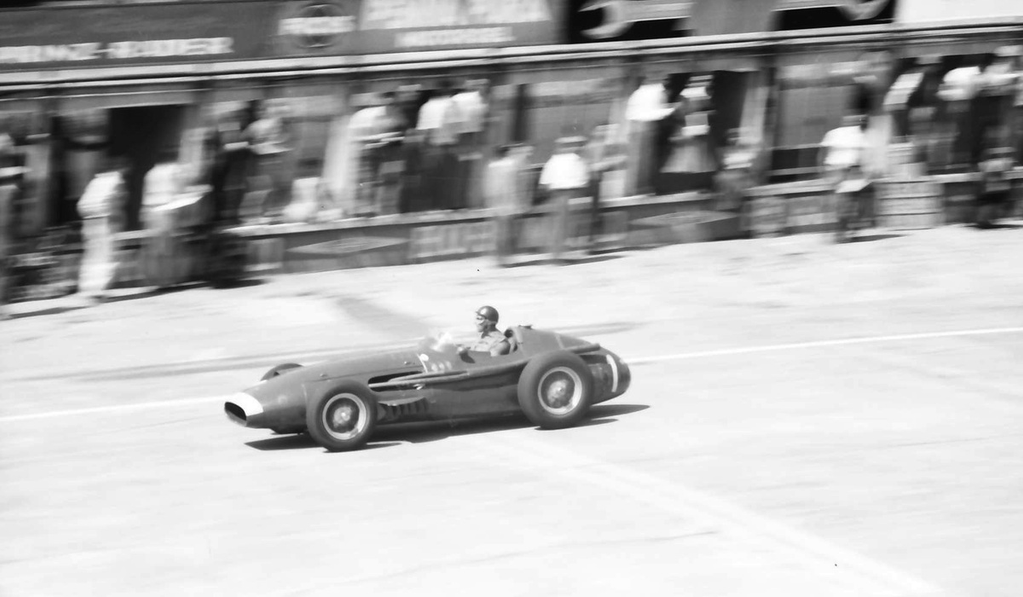
Fangio sits first on peak and on ratio. Five titles from seven full seasons, a win rate nobody since has approached, and he took them while moving between teams to get the best car available, which was less a strategy than a stated policy. He won a championship at forty-six years old, in an era when that was roughly the life expectancy of the job.
Schumacher is second for what he built rather than what he drove. A Ferrari team that had not won a drivers’ title in twenty-one years became, under him, a machine that won five in a row. He did it by reorganizing everything around himself, from testing to the people in the garage, which was not a skill the sport had previously asked of a driver.
I have watched a version of that at club level, on a scale roughly one-millionth the size. One driver joins a team, and within a season the trailer is organized differently, the tire log actually gets filled in, and everybody is half a second quicker. That person is rarely the most naturally gifted one in the group.
Senna is third, and this is where I expect most of the disagreement. Over a single lap, in the wet, he was the best there has ever been, and the qualifying record backs that up rather than merely decorating it. What keeps him third instead of first is consistency across a full season, where Prost beat him more often than the legend now allows.
Hamilton and Verstappen sit fourth and fifth, which is the part of the list that will age fastest. Hamilton has the longevity, the seven titles and a win record that may stand for a while. Verstappen has four titles and a 2025 season where he lost the championship by two points in a car that was not the quickest, which tells you more about him than the four titles do.
The ones who just missed
Stirling Moss never won a championship and belongs in any honest conversation about this, which tells you how blunt an instrument a top ten really is. Alberto Ascari won nine consecutive races across two seasons, a record that still stands. Gilles Villeneuve has a case built entirely on peak and on what his contemporaries said about him.
Lando Norris won the 2025 championship at twenty-six, and it is too early to say anything useful about where he lands. Ask me in eight years.
What the numbers cannot settle
Here is the honest problem with every list of this kind. Clark drove cars that killed people. Hamilton drove cars that have carbon fiber halos and crash structures tested to standards Clark’s generation would not have believed. Comparing them is comparing two different jobs that share a name.
The same applies to team size. Fangio raced with a mechanic and a stopwatch. A modern driver has four hundred people on the payroll and a simulator running overnight. Neither of those drivers could simply step into the other’s era and be as good, and anybody who tells you otherwise is selling something.
What I keep coming back to is teammate data, because it is the only genuinely controlled measurement the sport produces. Same car, same tools, same weekend, same engineers arguing about the same setup. Everything else on a list like this is context with a number attached to it.
Why we argue about it anyway
My ten is in the table above. Yours is different, and the gap between the two is the whole point of the exercise.
The argument at our folding table never got settled, though it did get better. Somebody would bring a statistic, somebody else would bring an entire season as a counterexample, and over six years I learned more racing history at that table than from any book on my shelf. One of the regulars kept a folder of printouts in his truck.
My own contribution, for the record, was a hard defense of Niki Lauda at number seven, which nobody accepted and I still believe. Then I would get up and get the next round, because I had said the phrase.
Questions about the greatest F1 drivers
Who is the greatest F1 driver of all time?
There is no settled answer. This list puts Juan Manuel Fangio first on peak level and win rate, with Michael Schumacher second and Ayrton Senna third.
Why is Lewis Hamilton not first?
He has the longevity and the win record, but the ranking weights peak level and teammate record above career totals, since the calendar is more than three times the length it was.
Where does Max Verstappen rank?
Fifth, with four consecutive titles from 2021 to 2024 and a 2025 season lost by two points. He is still racing, so the position is provisional.
Why is Stirling Moss not on the list?
He never won a championship, which is the weakness of any top ten. He belongs in the conversation regardless.
How were the drivers compared across different eras?
By peak level, teammate record and longevity rather than by raw totals. Comparing a 1960s season with a modern one directly does not work.
Jake Holloway is a club racer, track-day instructor, and motorsports editor based near Charlotte, North Carolina. He has raced karts, Legends cars, Spec Miatas, and amateur endurance cars, and he writes for GreenyCars about how racing actually works, from the rule book to the pit lane.
More Stories
The Dakar Rally and Why Finishing It Counts as Winning
The F1 Circuits Every Fan Should Know, and What Each One Is For
The F1 Races That Stayed Unsettled Until the End
F1 Driver Nicknames, the Professor to Mr. Saturday
How Endurance Racing Works, from Four Hours to Twenty-Four